MANE 6313
Week 14, Module A
Student Learning Outcome
- Select an appropriate experimental design with one or more factors,
- Select an appropriate model with one or more factors,
- Evaluate statistical analyses of experimental designs,
- Assess the model adequacy of any experimental design, and
- Interpret model results.
Module Learning Outcome
Critique Taguchi’s approach to experimental design.
Resources for the Week 14, Module A micro-lecture are:
Introduction to RPD
-
Robust parameter design or process robustness study is a technique developed by Taguchi
-
Utilizes designed experiments and novel methods for analyzing data
-
Focuses on choosing levels of controllable factor to:
-
ensure mean of output response is at a desired target and
-
ensure that the variability around the target value is as small as possible
-
-
Introduced into the US during the 1980s
-
Textbook focus is on applying RSM to RPD
Focus of Robust Design Problem
-
Designing systems that are insensitive to environmental factors that can affect performance once the system is deployed
-
Designing products so that they are insensitive to variability transmitted by the components of the system
-
Designing processes so that the manufactured product will be as close as possible the the desired target specifications
-
Determining the operating conditions for a process so that the critical process characteristics are as close as possible to the desired target values and the variability around this target is minimized
Taguchi Orthogonal Arrays
-
Taguchi's approach utilizes orthogonal arrays
-
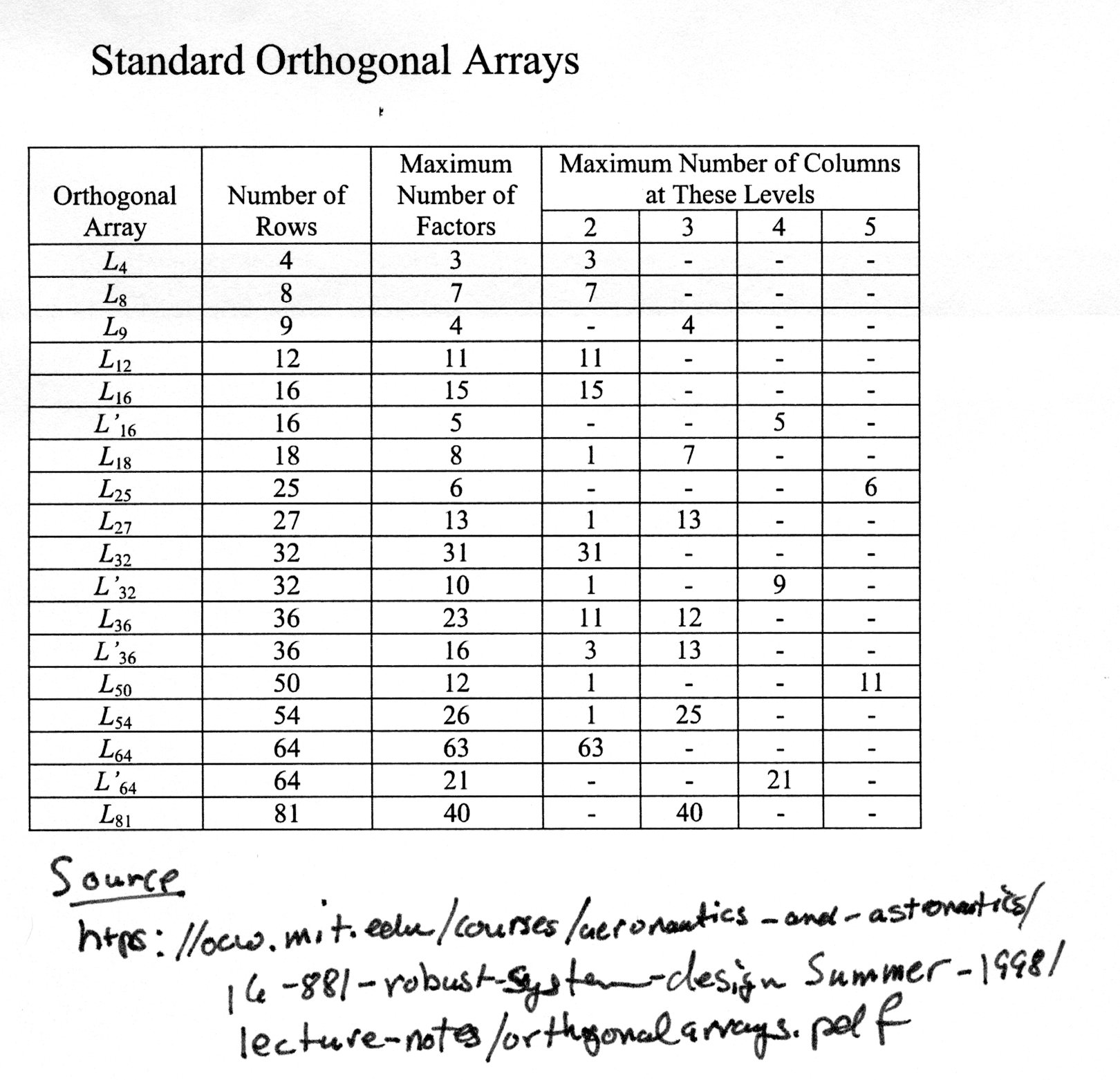
Standard orthogonal arrays are provided on the next slide
-
Taguchi's designs focuses on main effects and often ignore interactions
-
Minitab supports Taguchi Orthogonal arrays
Standard Orthogonal Arrays
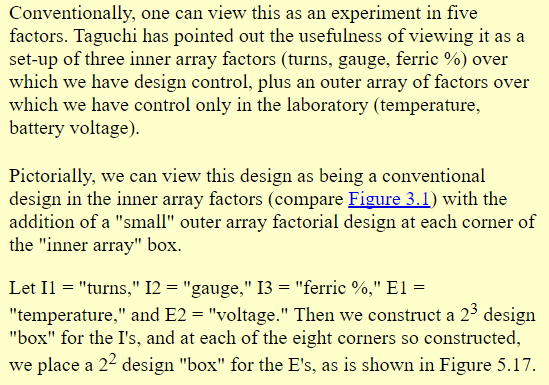
Crossed Array Design -- NIST
Crossed Array Design -- NIST
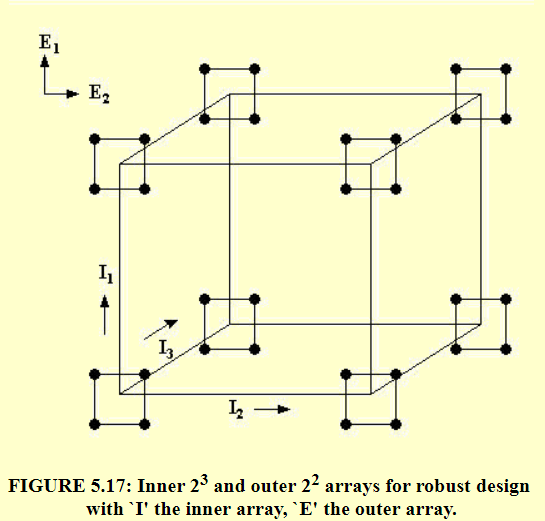
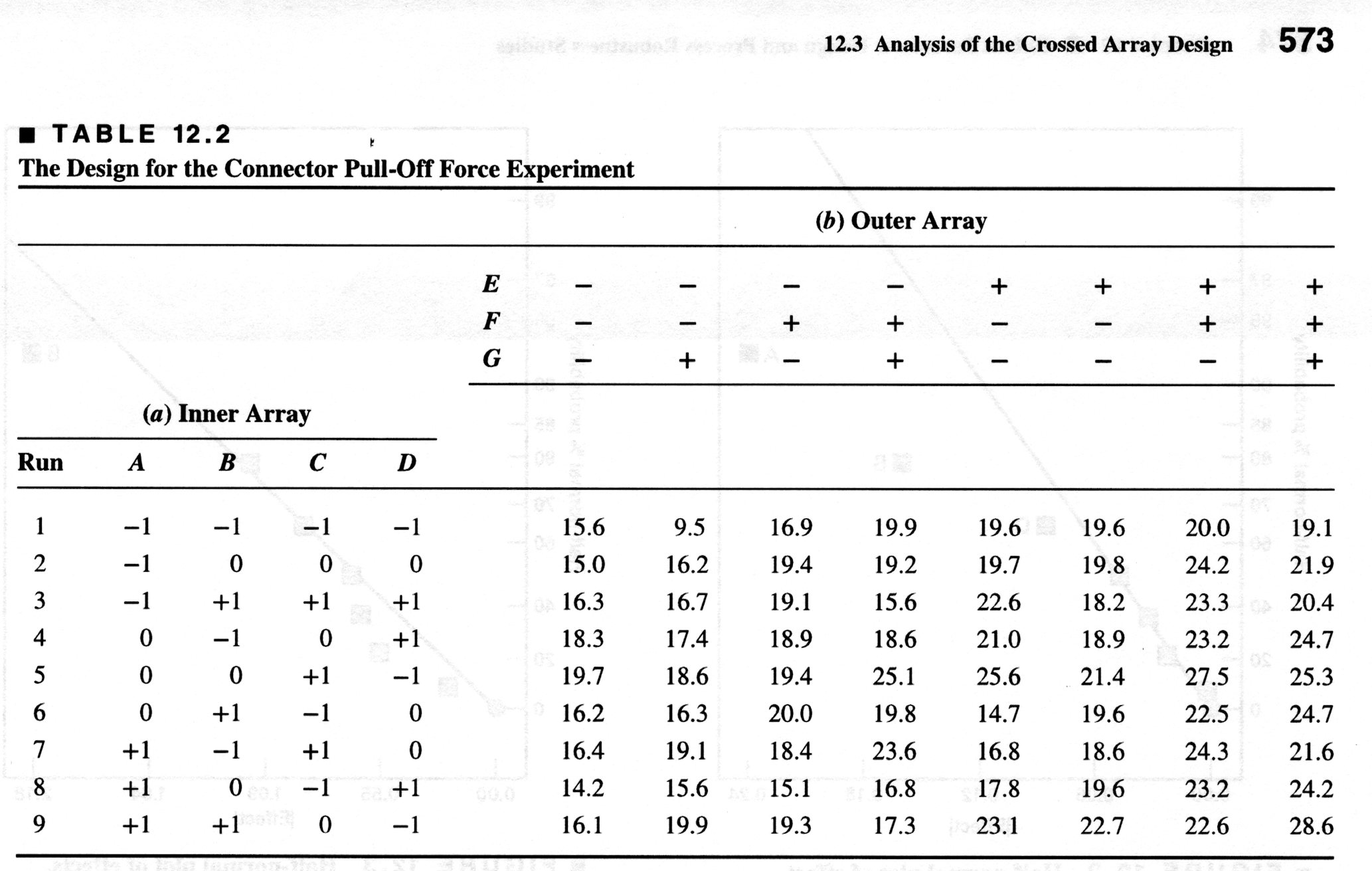
Table 12.2
Montgomery's Criticism
-
The mean (inner array) and variance (outer array) modeling approach using the crossed array design is that it does not take advantage of the interactions between controlled variables and noise variables
-
Variance response is likely to have a nonlinear relationship with the controllabe variables
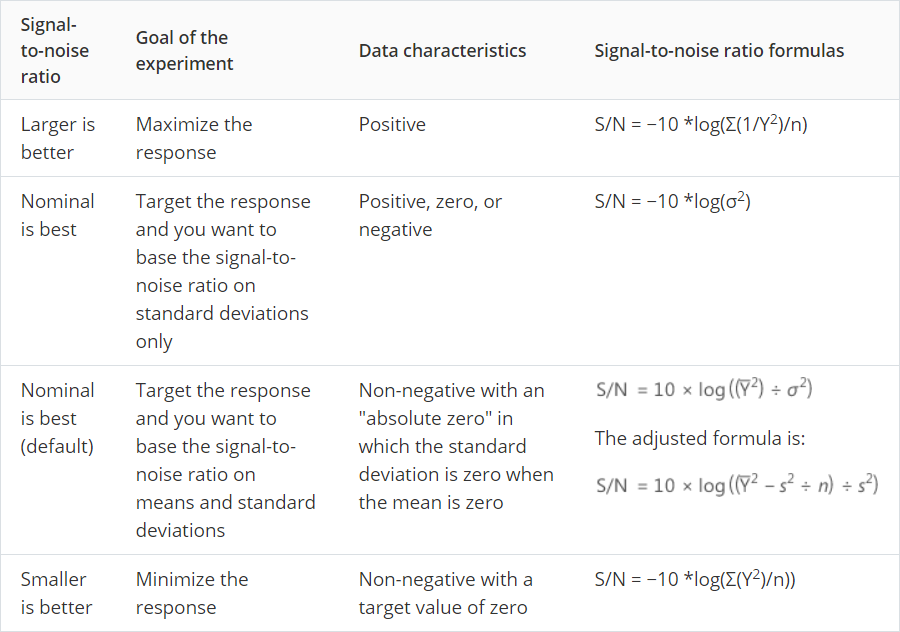
Signal to Noise Ratio (Minitab)
Montgomery's Recommendation
-
Use a combined array design that incorporates both controllable and noise variables without inner and outer arrays
-
Use response model
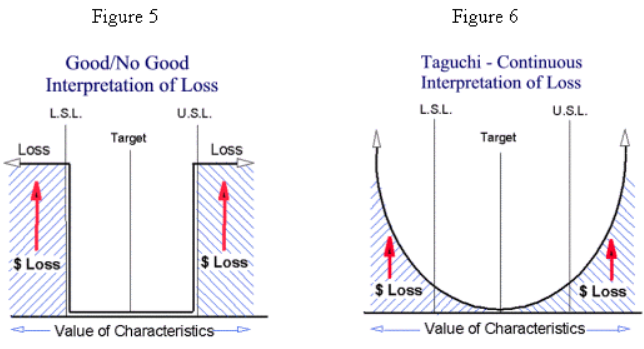
Taguchi Loss Function
Myers, Khuri, and Vining's Criticism
-
inefficiency of the signal-to-noise ratio
-
lack of flexibility in modeling design variables
-
lack of economy in experimental design plan
-
preoccupation with optimization
-
no formal allowance for sequential experimentation