MANE 6313
Week 14, Module C
Student Learning Outcome
- Select an appropriate experimental design with one or more factors,
- Select an appropriate model with one or more factors,
- Evaluate statistical analyses of experimental designs,
- Assess the model adequacy of any experimental design, and
- Interpret model results.
Module Learning Outcome
Explain mixture designs.
Resources for the Week 14, Module C micro-lecture are:
Introduction to Mixture Designs
-
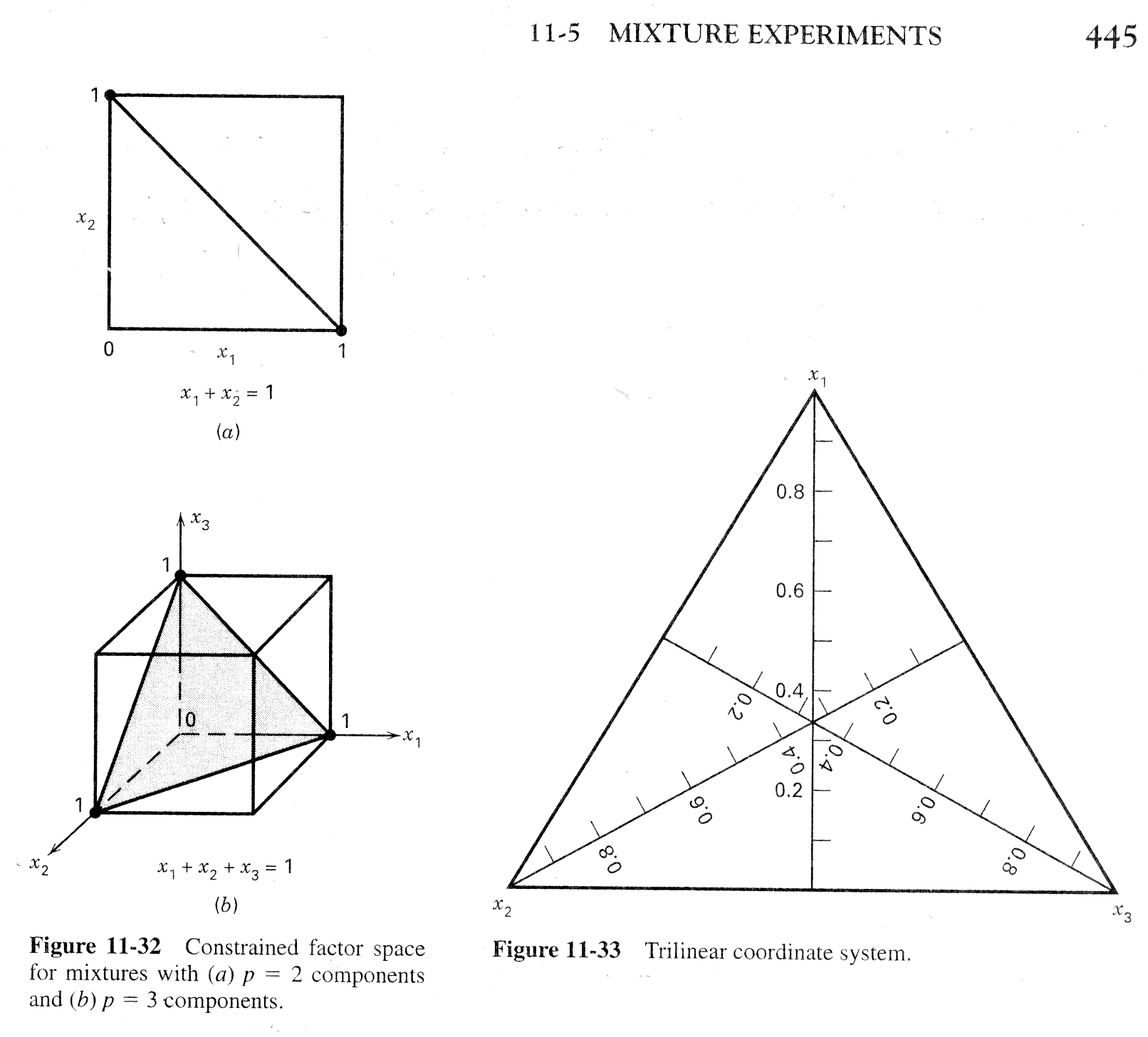
In previous situations, we have assumed that the levels of each factor are independent of the levels of all the other factors
-
This assumption does not hold in mixture experiments
-
Usually there is a restriction that the sum of components equals one
-
Examine Figure 11--39 on page 543
Simplex Lattice Designs
- A \(\left\{p,m\right\}\) lattice design for \(p\) components consists of \(m+1\) equally spaced values from 0 to 1
-
Examine Figure 11-41 on page 543
-
In general, a \({p,m}\) lattice design requires
$$ N=\frac{(p+m-1)!}{m!(p-1)!} $$ points
Simplex Centroid Design
-
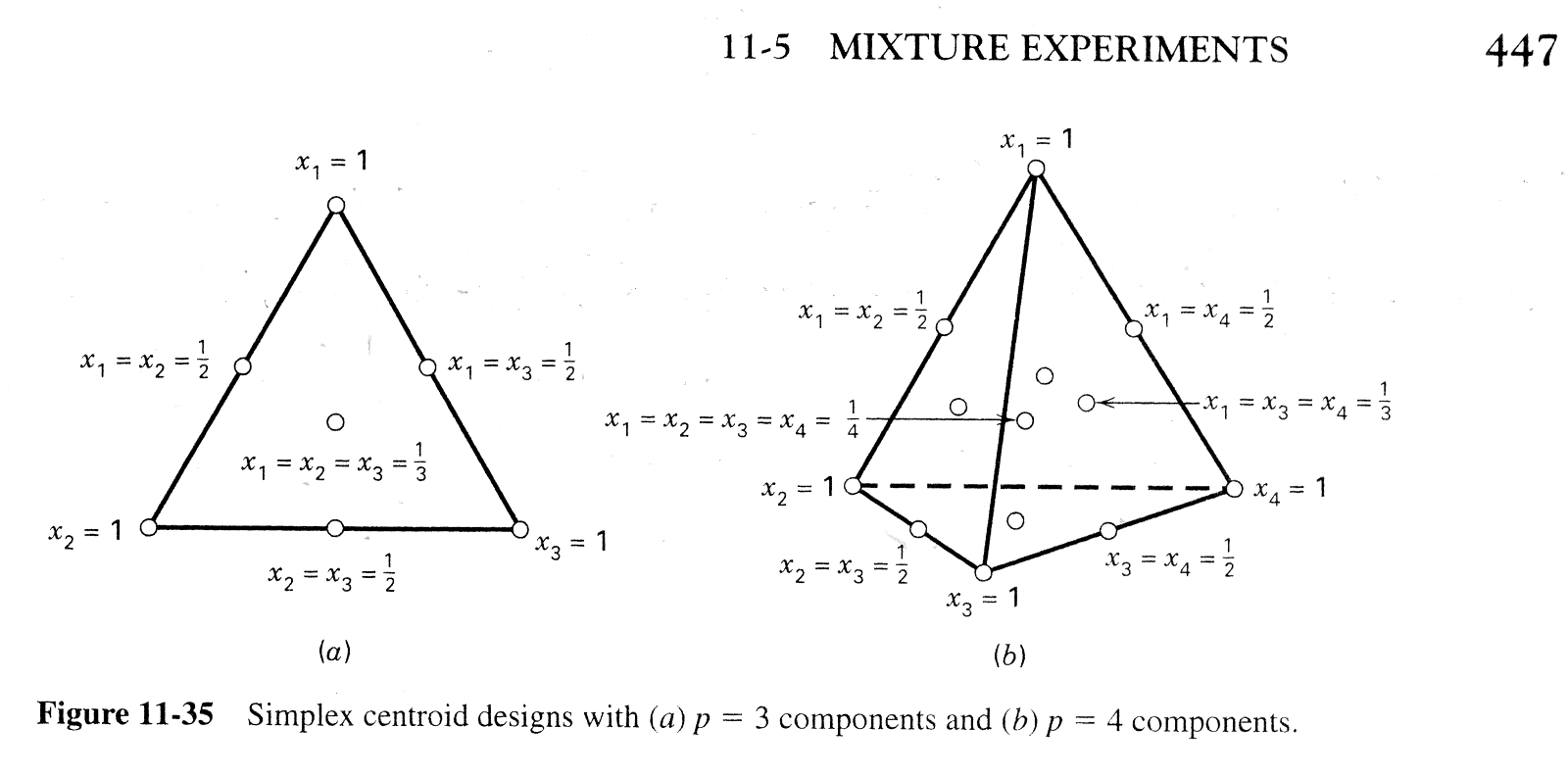
A design requiring \(2^p-1\) points corresponding to all permutations of the design points
-
See Figure 11--42 on page 544
-
A Criticism of the simplex designs is that most experiments occur along the boundary of the region and not in the interior of the design
Mixture Models
-
Recall that \(\sum x_i=1\)
-
Slightly different standard forms
-
Linear model
- Quadratic model
- Full cubic model
- Special Cubic model
Final Comments on Mixture Designs
-
Minitab supports centroid and lattice designs
-
Often require optimal design because of constraints on experimental region
-
Often requires higher-order terms
Minitab Mixture Design Demonstration
- Cornell (2002) provides an example of a {3,2} lattice design
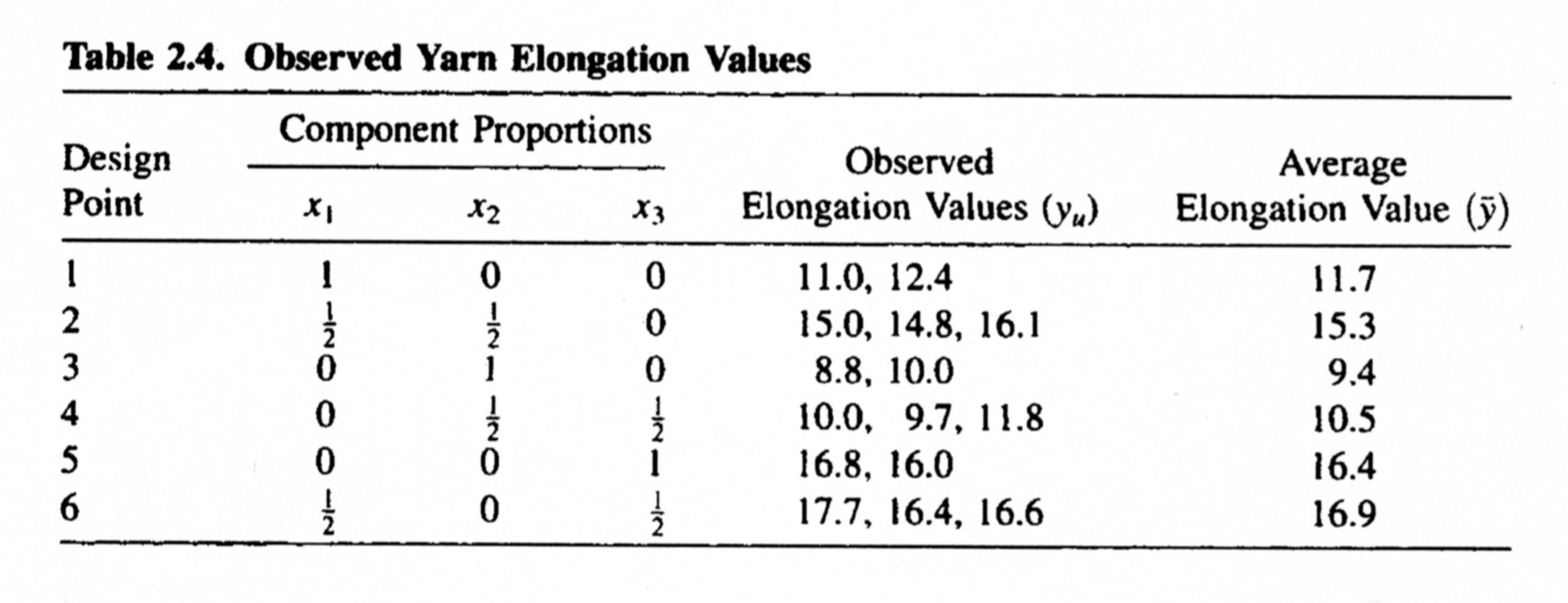
- Design Plot
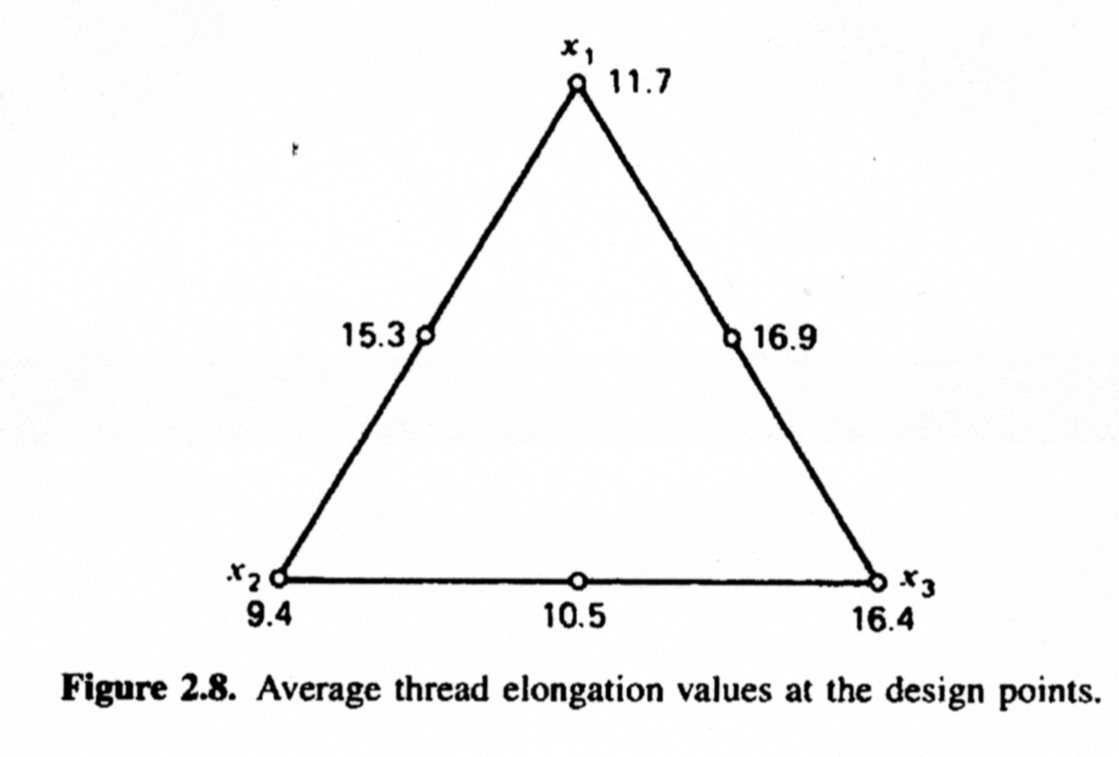
- Minitab demonstration