MANE 6313
Week 9, Module C
Student Learning Outcome
- Select an appropriate experimental design with one or more factors,
- Select an appropriate model with one or more factors,
- Evaluate statistical analyses of experimental designs,
- Assess the model adequacy of any experimental design, and
- Interpret model results.
Module Learning Outcome
Describe resolution of an experimental design.
Resources for the Week 9, Module C micro-lecture are:
Resolution of Experimental Design
-
Definition. A design is of resolution \(R\) if no \(p\)-factor effect is aliased with another effect containing less than \(R-p\) factors.
-
The three most common design resolutions are:
-
Resolution III designs. No main effect is aliased with any other main effect, but main effects are aliased with two-factor interactions and two-factor interactions may be aliased with each other.
-
Resolution IV designs. No main effect is aliased with any other main effect or with any two-factor interaction, but two interactions are aliased with other two-factor interactions
-
-
Resolution V designs. No main effect or two-factor interactions is aliased with any other main effect or two-factor interaction, but two-factor interactions are aliased with three-factor interactions.
-
In general, the resolution of a two-level fractional factorial design is equal to the smallest number of letters in the defining relation.
Projection of Fractions into Factorials
-
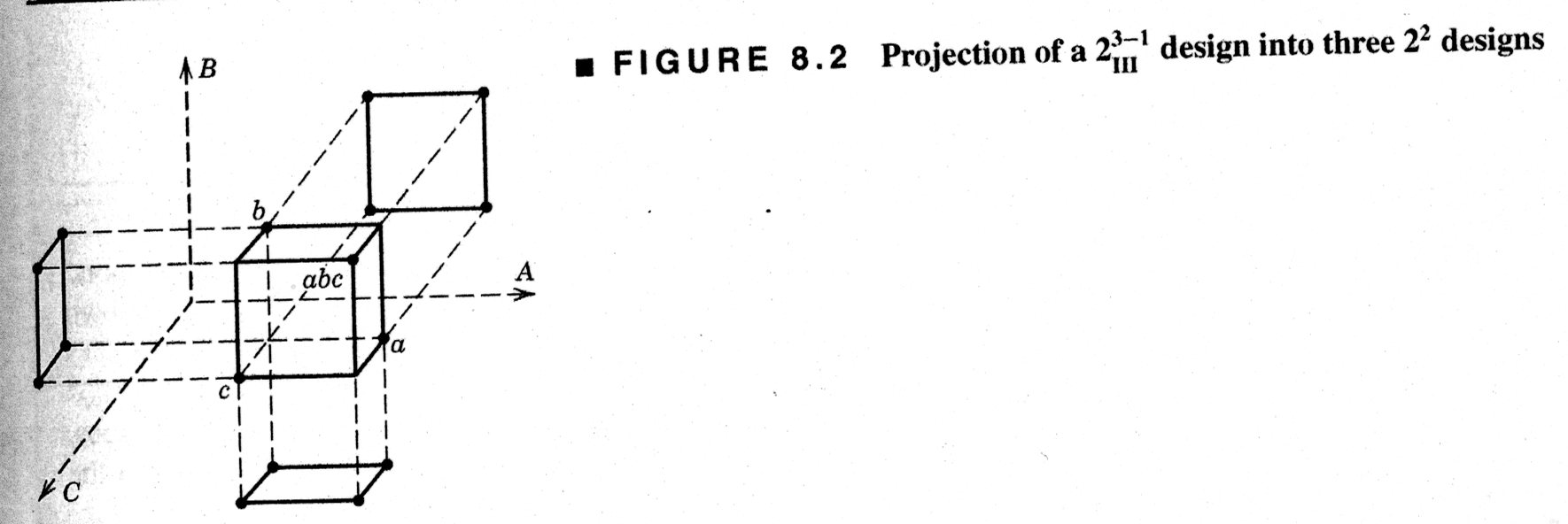
Any fractional factorial design of resolution \(R\) contains complete factorial designs (possibly replicated factorials) in any subset of \(R-1\) factors
-
Very useful result in screening experiments
-
If we can eliminate variables as being non-significant, the fractional factorial design may become a (replicated) factorial design
- See figure 8.2 on page 333 of your textbook.