MANE 6313
Week 6, Module F
Student Learning Outcome
- Select an appropriate experimental design with one or more factors,
- Select an appropriate model with one or more factors,
- Evaluate statistical analyses of experimental designs,
- Assess the model adequacy of any experimental design, and
- Interpret model results.
Module Learning Outcome
General Factorial Design
Resources for the Week 6, Module F micro-lecture are:
General Factorial Design
-
We will assume \(n\geq 2\) so we can include all two-factor interactions and estimate SS-error
-
For a fixed model with 3 factors we use the following model
- Sum of squares equations given on pages 201-202 (no surprises)
Important Point
-
The ANOVA and analysis is always the same for experiments with fixed factors
-
The presence of random factors complicates the design
-
The expected mean squares must be calculated and the divisor will not always be MS(error)!
-
Discussed in chapter 12 (not covered in class).
Blocking in a Factorial Design
-
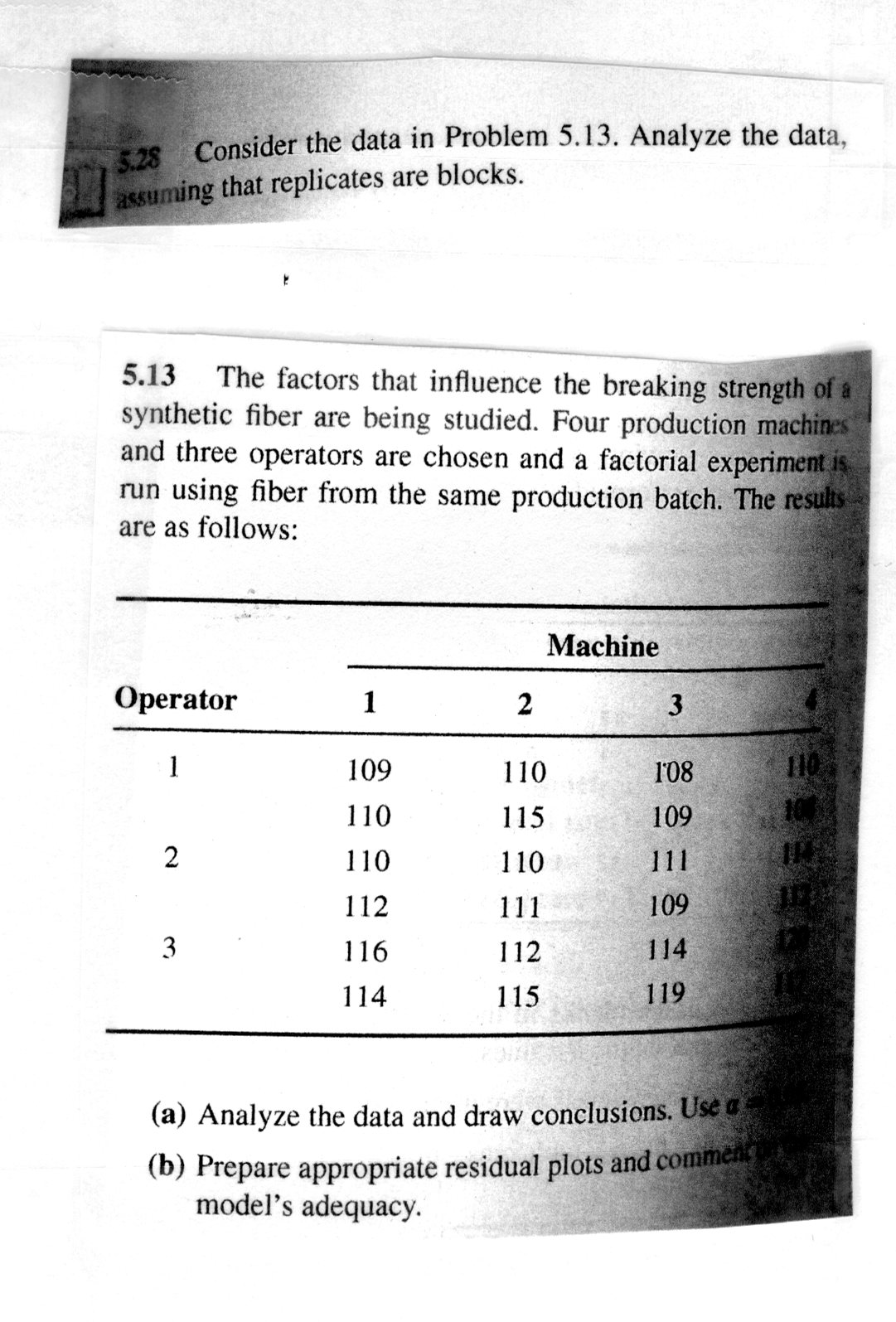
Consider the two-factor factorial design conducted as a randomized block design
-
The statistical model is
where \(\delta_k\) is the block effect.
-
The model assumes that interactions between blocks and treatments is negligible.
-
If these interactions exist, they can not be separated from the error component.
-
Sum of squares formulas and an example ANOVA are given in table 5-20 on page 215.
Problem 5.28