MANE 6313
Week 9, Module E
Student Learning Outcome
- Select an appropriate experimental design with one or more factors,
- Select an appropriate model with one or more factors,
- Evaluate statistical analyses of experimental designs,
- Assess the model adequacy of any experimental design, and
- Interpret model results.
Module Learning Outcome
Describe a general 2^(k-p) fractional factorial design.
Resources for the Week 9, Module E micro-lecture are:
The general \(2^{k-p}\) Fractional Factorial Design
-
A \(2^k\) fractional factorial design containing \(2^{k-p}\) runs is called a \(1/2^p\) fraction of the \(2^k\) design
-
These designs requires \(p\) independent generators (same definition from last week).
-
There are \(2^p-p-1\) generalized interactions included
-
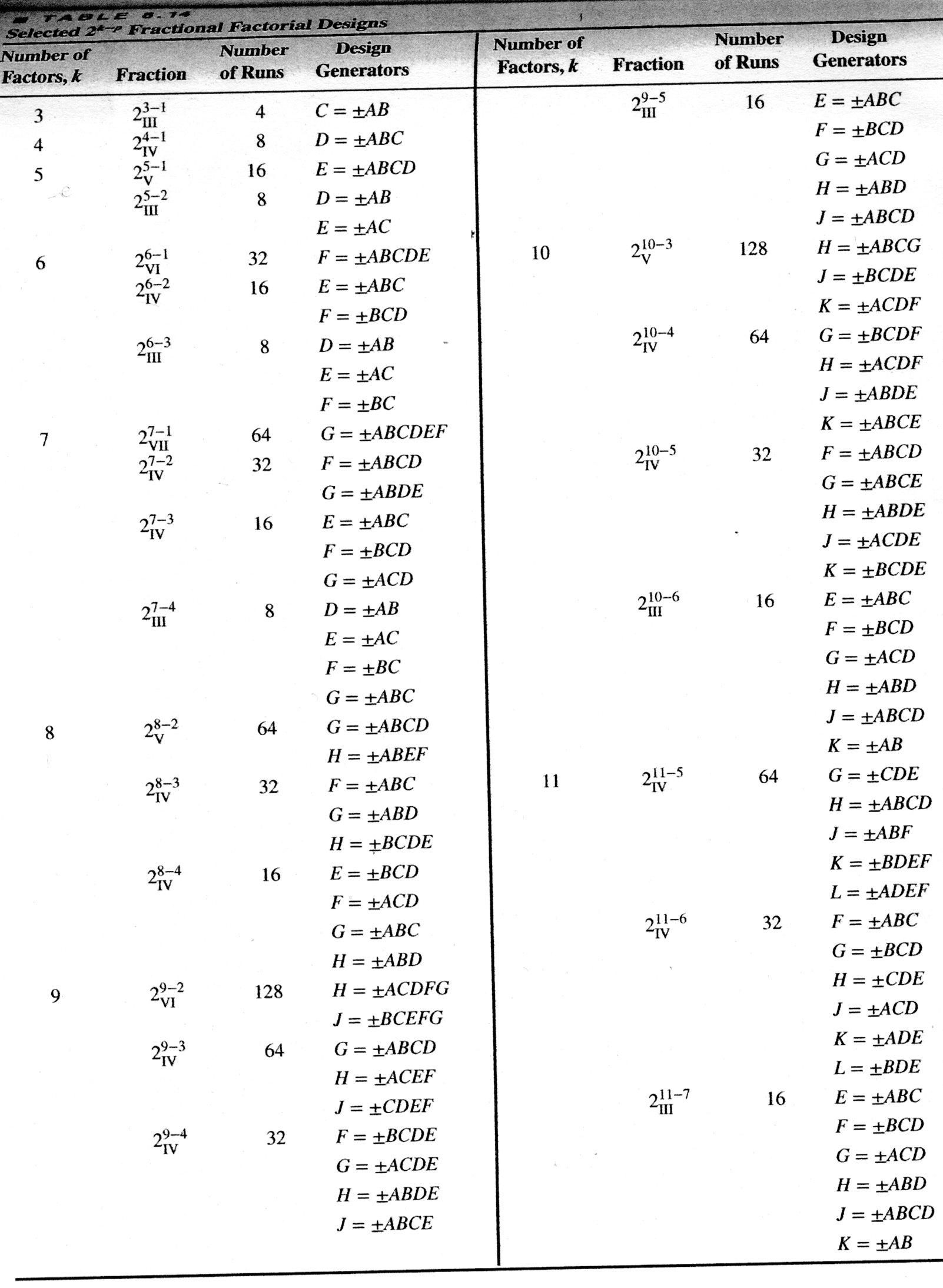
There is an "art" to selecting the correct generators. Look to table 8.14 (page 353) for suggestions.
Table 8.14
Appendix X
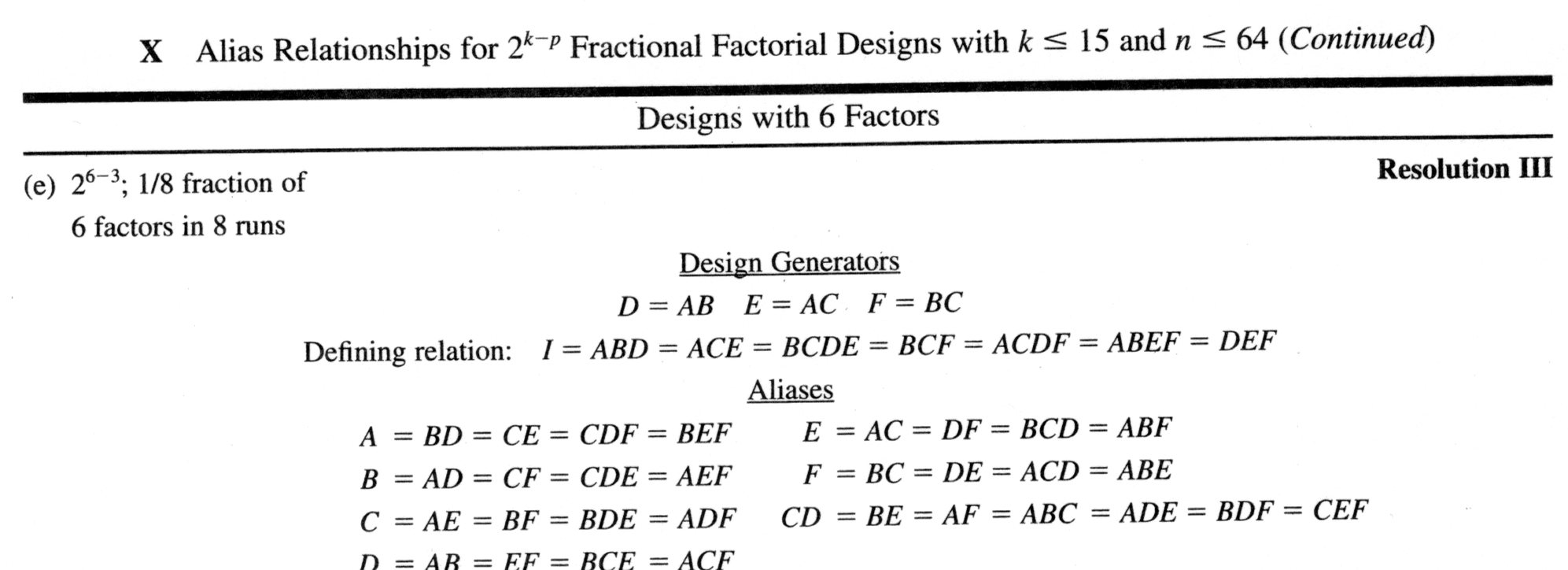
Resolution III Designs
-
It is possible to construct resolution III designs for investigating up to \(k=N-1\) factors in \(N\) runs when \(N\) is a multiple of 4
-
These experiments are said to be saturated
-
Pay particular attention to Sequential assembly of fractions to separate effects.
Minitab
-
Example problems demonstrate the use of Minitab for fractional factorials
-
Minitab provides excellent support