MANE 3351
Lecture 13, October 4
Classroom Management
Agenda
- Lab today in ENGR 2.268 at 3:30 pm
- GitHub Accounts
- Sign up for free student GitHub account at https://education.github.com/students
- Register your student GitHub account with MANE 3351 GitHub classroom email
- Lecture
Resources
Handouts
Calendar
| Lecture | Date | Content |
|---|---|---|
| 1 | August 23 | Welcome to Class, Syllabus |
| 2 | August 25 | Error Analysis |
| 3 | August 30 | Introduction to Jupyter Notebook |
| 4 | September 1 | Markdown |
| 5 | September 6 | Labor Day Holiday |
| 6 | September 8 | Taylor Polynomials, Homework 1 |
| 7 | September 13 | Roots of Equations, Bisection Method |
| 8 | September 15 | Bisection Error Analysis |
| 9 | September 20 | False Position Algorithm |
| 10 | September 22 | Newton Raphson Algorithm |
| 11 | September 27 | Secant Method |
| 12 | September 29 | Numerical Integration |
Assignments
- Homework 3 (assigned 9/22/2021, due 9/30/2021)
Looking Ahead
| Lecture | Date | Content |
|---|---|---|
| 13 | October 4 | Simpson's Rule |
| 14 | October 6 | Romberg Integration |
| 15 | October 11 | Gaussian Quadrature (end of material for Test 1) |
| 16 | October 13 | Vectors |
| 17 | October 18 | Vector Operations |
| 18 | October 20 | Test 1 |
Lecture 13, October 4
Today's topic is Simpson's Rule.
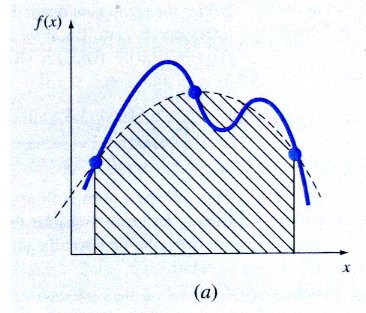
- Simpson's (1/3) rule is Newton-Cotes with \(n=2\)
- Chapra and Canale (2015)3 illustrate Simpson's rule in the figure shown below
Definition of Simpson's Rule
- Chapra and Canale(2015)3 provide the following definition of Simpson's rule
\[
I=\frac{h}{3}\left[f(x_0)+4f(x_1)+f(x_2)\right]
\]
where \(h=(b-a)/2\)
- Note that Simpson's rule is of the form
\[
\begin{aligned}
I&\approx \left(b-a\right)\frac{f(x_0)+4f(x_1)+f(x_2)}{6}\\
I&\approx\mbox{ width}\times\mbox{ average height}
\end{aligned}
\]
Simpson's Rule Error Analysis
- Chapra and Canale (2015)3 provides the following definition:
\[
\begin{aligned}
I&=\frac{h}{3}\left[f(x_0)+4f(x_1)+f(x_2)\right]-\frac{1}{90}f^{(4)}(\xi)h^5\\
I&=\mbox{Simpson's 1/3 approximation}-\mbox{ Truncation error}
\end{aligned}
\]
Multiple Applications of Simpson's Rule
- The number of segments must be even
- The formula is
\[
I\approx\left(b-a\right)\frac{f(x_0)+4\sum_{i=1,3,5}^{n-1}f(x_i)+2\sum_{j=2,4,6}^{n-2}f(x_j)+f(x_n)}{3n}
\]
where \(h=\frac{b-a}{n}\)
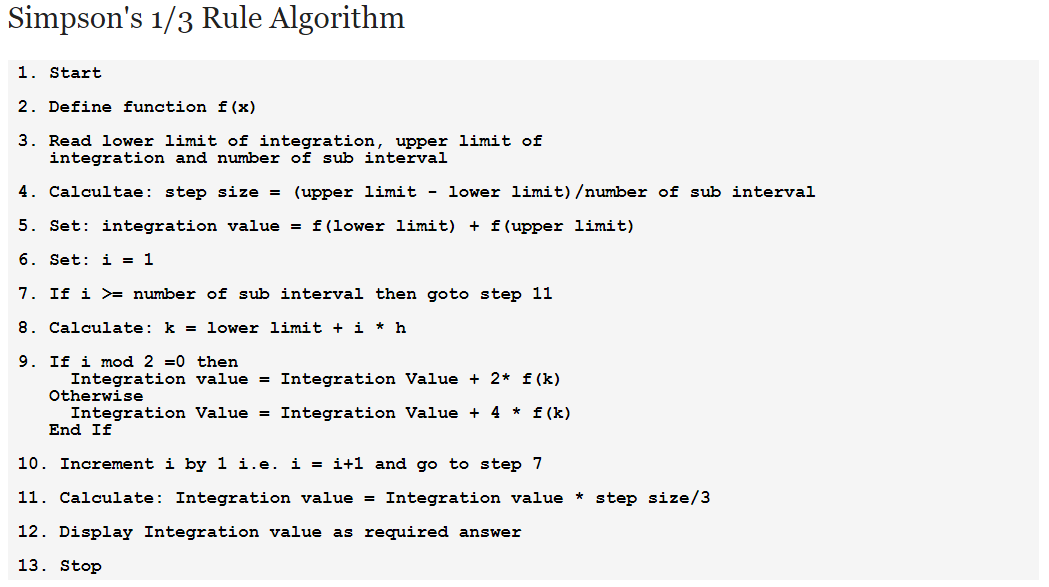
Pseudo-code: Simpson's 1/3 Rule
- CodeSansar4 provides the following pseudo-code
Jupyter Notebook Demonstration
Simpson's 3/8 Rule
- Simpson's 3/8 rule is Newton-Cotes with \(n=3\)
- Chapra and Canale (2015)3 illustrate Simpson's rule in the figure shown below

Definition of Simpson's 3/8 Rule
- Chapra and Canale(2015)3 provide the following definition of Simpson's rule
\[
I=\frac{3h}{8}\left[f(x_0)+3f(x_1)+3f(x_2)+f(x_3)\right]
\]
where \(h=(b-a)/3\)
- Note that Simpson's 3/8 rule is of the form
\[
\begin{aligned}
I&\approx \left(b-a\right)\frac{f(x_0)+3f(x_1)+3f(x_2)+f(x_3)}{8}\\
I&\approx\mbox{ width}\times\mbox{ average height}
\end{aligned}
\]
Truncation Error of Simpson's 3/8 Rule
\[
\begin{aligned}
E_t&=-\frac{3}{80}h^5f^{(4)}(\xi)\\
&=-\frac{\left(b-a\right)^5}{6480}f^{(4)}(\xi)
\end{aligned}
\]
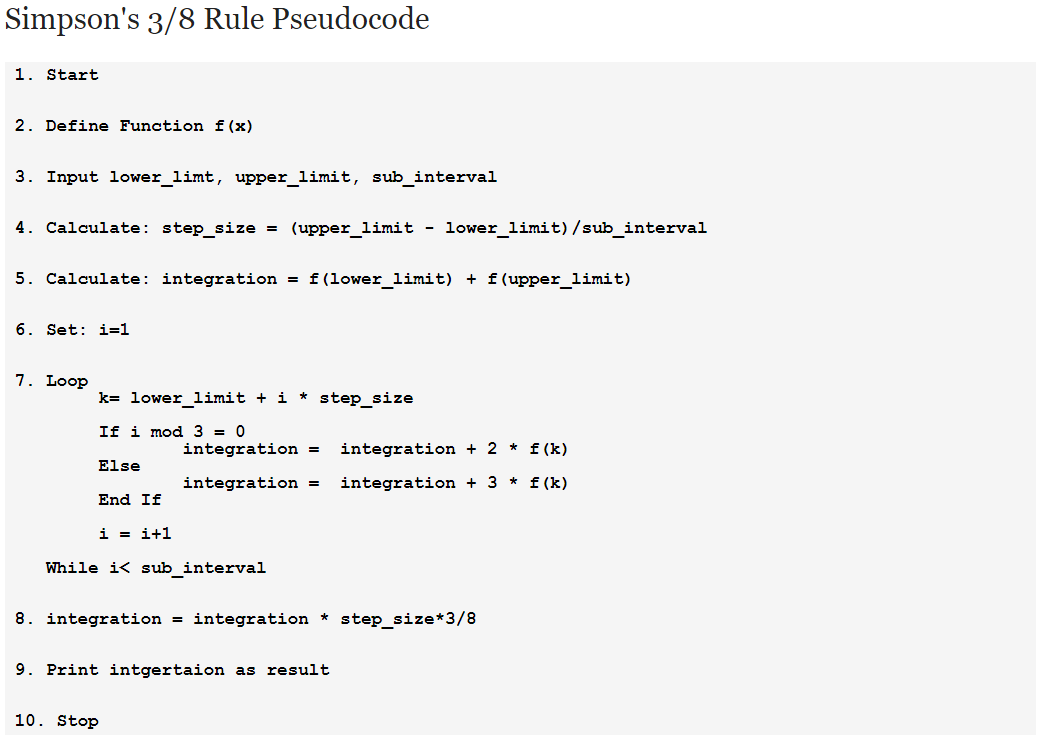
Pseudo-code: Simpson's 3/8 Rule
CodeSansar5 provides the following pseudo-code for Simpson's 3/8 Rule
-
Cheny, W., and Kincaid, D., (2004), Numerical Mathematics and Computer, 5th edition ↩
-
Kiusalaas, J. (2013), Numerical Methods in Engineering with Python 3 ↩
-
Chapra, S., and Canale, R., (2015), Numerical Methods for Engineers, 7th edition ↩↩↩↩↩
-
https://www.codesansar.com/numerical-methods/integration-simpson-1-3-method-algorithm.htm ↩
-
https://www.codesansar.com/numerical-methods/integration-simpson-3-8-method-pseudocode.htm ↩