MANE 3351
Lecture 10, September 22
Classroom Management
Agenda
- Update on Raspberry Pi VM
- Lecture
- Lab today!
Resources
Handouts
Calendar
| Lecture | Date | Content |
|---|---|---|
| 1 | August 23 | Welcome to Class, Syllabus |
| 2 | August 25 | Error Analysis |
| 3 | August 30 | Introduction to Jupyter Notebook |
| 4 | September 1 | Markdown |
| 5 | September 6 | Labor Day Holiday |
| 6 | September 8 | Taylor Polynomials, Homework 1 |
| 7 | September 13 | Roots of Equations, Bisection Method |
| 8 | September 15 | Bisection Error Analysis |
| 9 | September 20 | False Position Algorithm |
| 10 | September 22 | Newton Raphson Algorithm |
Assignments
- Homework 2 (assigned 9/15/2021, due 9/23/2021)
- Homework 3 (assigned 9/22/2021, due 9/30/2021)
Lecture 10, September 22
Both the bisection and False Position methods were bracketing approaches to find roots that required two starting points that "bracketed" the root. Today's topic, Newton's method or Newton-Raphson method, require only one starting point. Newton's method also requires the knowledge of the derivative.
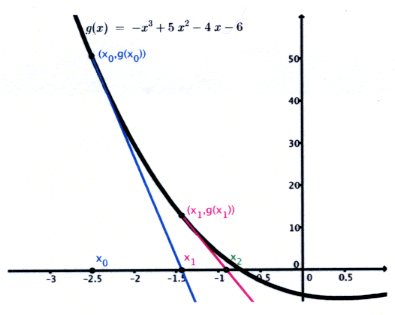
Geometric Inspiration
Brin (2020)1 demonstrate the geometric inspiration for Newton's method
Newton's Method
- The formula is simply
New Example Problem
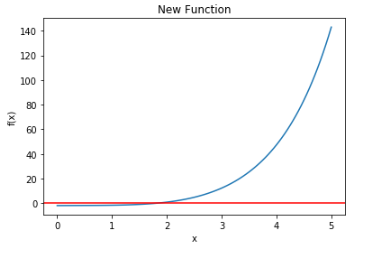
- Consider a new function, \(f(x)=e^x+2^{-x}+2\cos(x)-6=0\)
First Derivative
- Newton's Method requires the first derivative:
Review of Derivatives
- An excellent table derivatives is found at Engineering LibreTexts
- A helpful site is Derivative Calculator
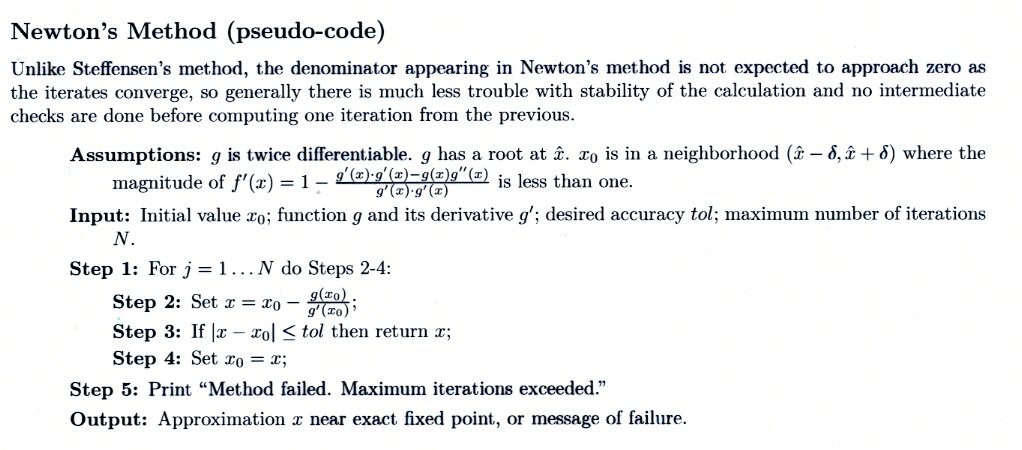
Pseudo-code
Brin (2020)1provides the following pseudo-code
Jupyter Notebook Demonstration
Convergence
- Cheney and Kincaid (2004)2 study the performance of Newton's methods
- Assumptions
- \(f\) contains two continuous derivatives, \(f^\prime\) and \(f^{\prime\prime}\)
- \(r\) is a simple root, \(f^\prime(r)\neq 0\)
- If \(r\) is started sufficiently close to \(r\), converges quadratically to \(r\)
-
\(|r-x_{n+1}|\leq c|r-x_n|^2\)
-
In other words, \(x_{n+1}\) has approximately twice as many correct digits as \(x_n!\)
Other Comments
Kiusalaas (2013)3 provides the following introduction to the Newton-Raphson Method
The Newton-Raphson algorithm is the best known method of finding roots for a good reason: It is simple and fast. The only drawback of the methods is that it uses the derivative \(f^\prime(x)\) of the function as well as the function \(f(x)\) itself. Therefore, the Newton-Raphson method is usable only in problems where \(f^\prime(x)\) can be readily computed.
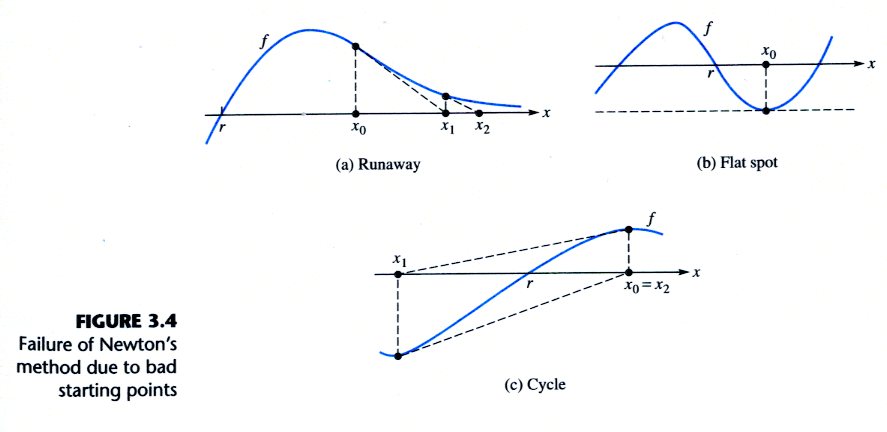
Importance of Good Starting Point
Cheney and Kincaid (2004)2, provide several illustrations of bad starting points and the problems that can occur.