MANE 3351
Lecture 8, September 15
Classroom Management
Agenda
- Proctor & Gamble
- Lecture
- Handout Raspberry Pi
- No lab today
Resources
Handouts
Calendar
| Lecture | Date | Content |
|---|---|---|
| 1 | August 23 | Welcome to Class, Syllabus |
| 2 | August 25 | Error Analysis |
| 3 | August 30 | Introduction to Jupyter Notebook |
| 4 | September 1 | Markdown |
| 5 | September 6 | Labor Day Holiday |
| 6 | September 8 | Taylor Polynomials, Homework 1 |
| 7 | September 13 | Roots of Equations, Bisection Method |
| 8 | September 15 | Bisection Error Analysis |
Assignments
- Homework 1 (assigned 9/8/2021, due 9/16/2021)
- Homework 2 (assigned 9/15/2021, due 9/23/2021)
Bisection Method: Error Analysis
Bisection Method Theorem
Cheney and Kincaid (2004)[^1] provide a definition of the bisection method
If the bisection algorithm is applied to a continuous function on an interval \([a,b]\), where \(f(a)f(b)<0\), then, after \(n\) steps, an approximate root will have been computed with error at most \((b-a)/2^{n+1}\).
This definition provides the following useful results:
- \(|e_n|\leq \frac{1}{2^{n+1}}(b-a)\)
- \(n> \frac{\log\left(b-a\right) -\log 2\varepsilon}{\log 2}\)
Percent Relative Error
Chapra and Canale (2015) [^2] provide a formula for the approximate percent relative error
- \(\varepsilon_a=\left|\frac{x_r^{new}-x_r^{old}}{x_r^{new}}\right|100\%\) where \(x_r^{new}\) is the root for the present iteration and \(x_r^{old}\) is the root from the previous iteration
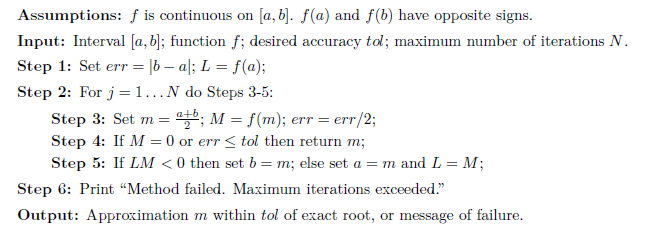
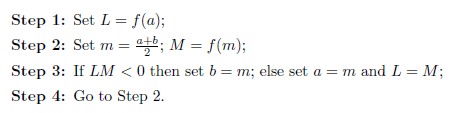
Pseudo Code
- "Pseudocode is an informal high-level description of the operating principle of a computer program or other algorithm"[^3]
- Highly encourage textbook recommendation: "Though technically no necessary for coding, when we can, we will preface each method's pseudo-code with mathematical assumptions that guarantee success.", page 39
First example of Pseudo-code for Bisection
Second Example of Pseudo-code for Bisection
Review Jupyter Notebook for Monday
Error for Monday's First Quartile Example
[1]: Cheney, W. and Kincaid, D. (2004), Numerical Mathematics and Computing, 5th edition
[2]: Chapra, S. and Canale, R. (2015), Numerical Methods for Engineering, 7th edition
[3]: Source: http://en.wikipedia.org/wiki/Pseudocode