MANE 6313
Week 13, Module E
Student Learning Outcome
- Select an appropriate experimental design with one or more factors,
- Select an appropriate model with one or more factors,
- Evaluate statistical analyses of experimental designs,
- Assess the model adequacy of any experimental design, and
- Interpret model results.
Module Learning Outcome
Generate Box-Behnken Design in R
bbd() Function

Example Problem
- Taken from Dean, Voss, and Drajuljic (2016)[^1]
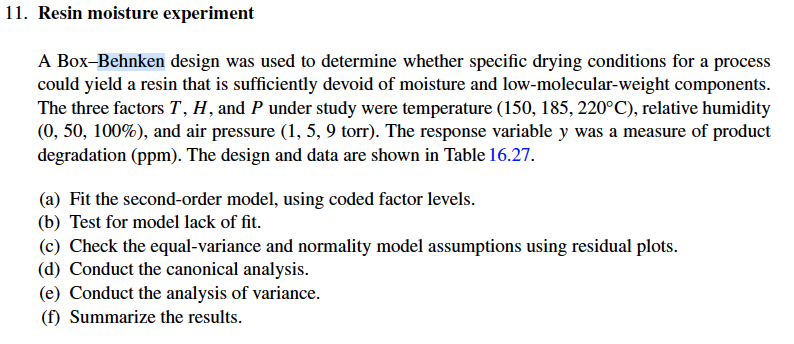
Example Problem, Data Table
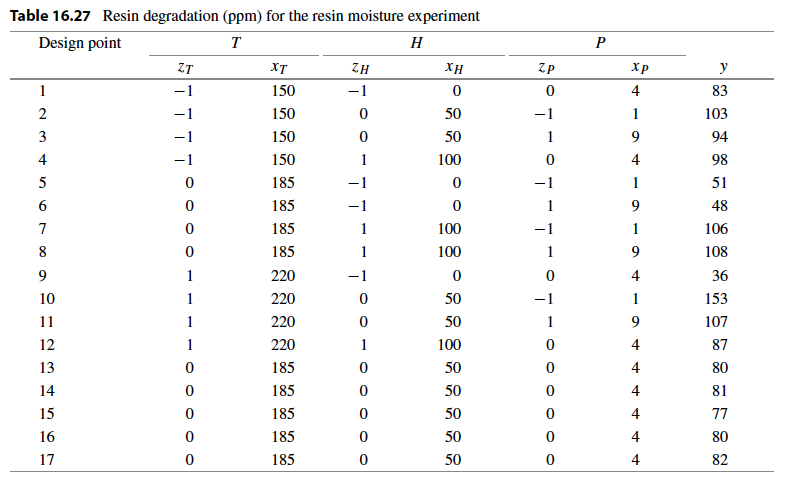
Coding Formula
\[
\begin{aligned}
x_1&\sim (temp-185)/35\\
x_2&\sim (humidity-50)/50\\
x_3&\sim (pressure-5)/4
\end{aligned}
\]
R Chunk for Box-Behnken Design
library(rsm)
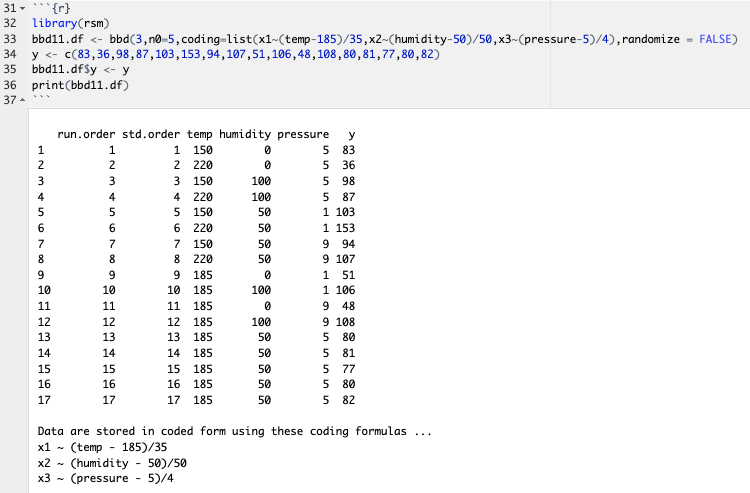
bbd11.df <- bbd(3,n0=5,coding=list(x1~(temp-185)/35,x2~(humidity-50)/50,x3~(pressure-5)/4),randomize = FALSE)
y <- c(83,36,98,87,103,153,94,107,51,106,48,108,80,81,77,80,82)
bbd11.df$y <- y
print(bbd11.df)
R Chunk for Box-Behnken Design Output
R Chunk for Fitting Model
Model Output, part 1
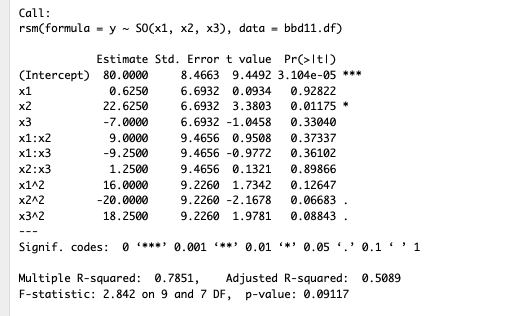
Model Output, part 2
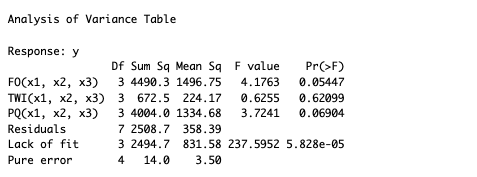
Model Output, part 3
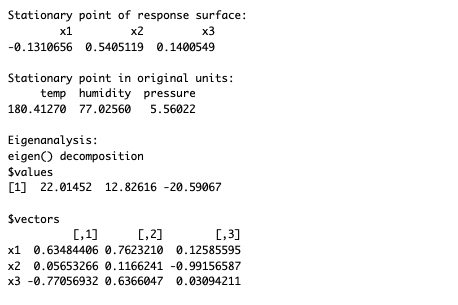
Model Refinement
- For this example, we will use \(\alpha=0.1.\)
- Start with pure quadratic and work back to first order
- For pure quadratic, x2 and x3 are statistically significant using \(\alpha=0.1\)
- For two-factor interactions, no factors are statistically significant
- For first order, x2 is statistically significant
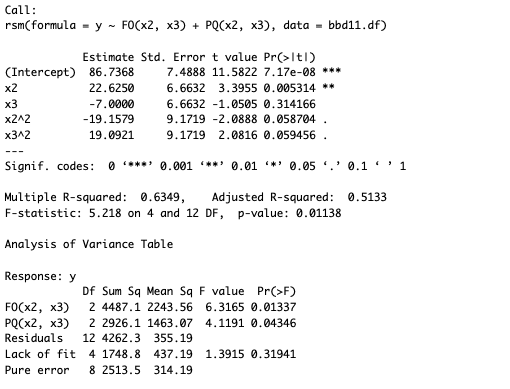
- Using hierarchy, the model will be FO(x2,x3)+PQ(x2,x3)
Second Model, R Chunk
Second Model, Output
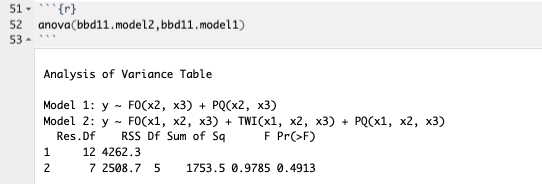
Partial F- Test
[^1]: Dean, Voss, and Drajuljic (2017). Design and Analysis of Experiments, 2nd edition. Springer Texts in Statistics.