MANE 6313
Week 3, Module B
Student Learning Outcome
Analyze simple comparative experiments and experiments with a single factor.
Module Learning Outcome
Review of (statistical) hypothesis testing.
Hypothesis Testing
- A Statistical Hypothesis is a statement about the values of the parameters of a probability distribution. For example:
-
The Null Hypothesis is given by \(H_0\) and is assumed to be true
-
The Alternative Hypothesis is given by \(H_A\). We are trying to gather evidence to support the claim of the alternative hypothesis
-
Hypotheses may be either two-sided or one-sided
Hypothesis Testing
-
You should be familiar with hypothesis testing.
-
You are responsible for the following material:
-
Tests on means with variance known (Table 2-4)
-
Tests on means of normal distribution with variance unknown(Table 2-4)
-
Paired comparison test (section 2-5)
-
Tests on variances of normal distribution (Table 2-8)
-
Overview: Conducting a Test of Hypothesis
-
Take a random sample from the population under study
-
Compute the appropriate statistic
-
Decide to either reject or fail to reject \(H_0\)
The set of values of the test statistic leading to the reject of \(H_0\) is called the rejection region or critical region.
Errors in Hypothesis Testing
- A Type I error occurs when the null hypothesis is true but the decision is made to reject \(H_0\)
- A Type II error occurs when the null hypothesis is false but the decision is made not to reject \(H_0\)
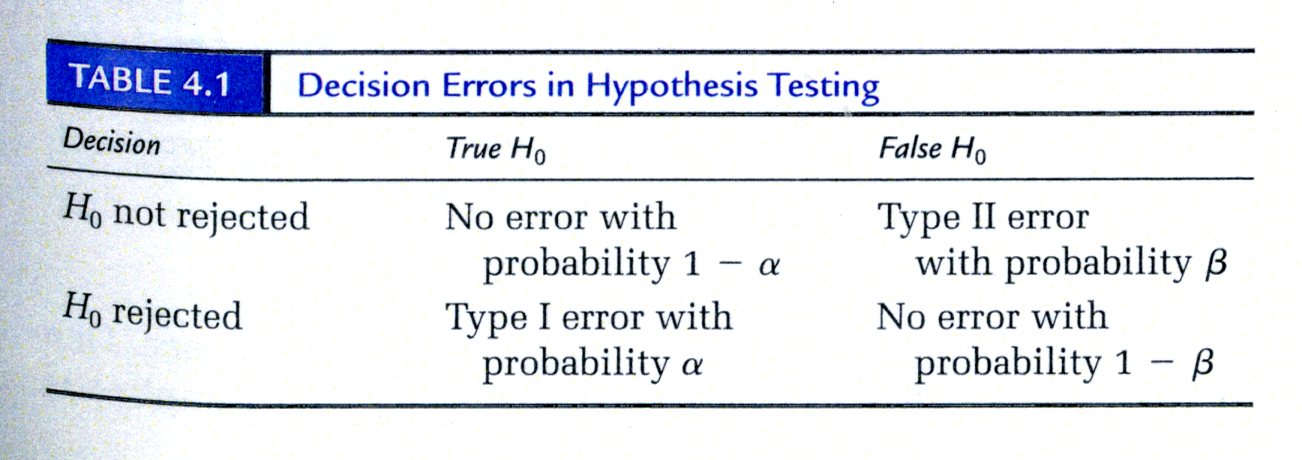
Source[^3]
Questions
-
Which type of error is the producer's risk?
-
Which type of error is the consumer's risk?
Classical Approach
Steps taken from [^1]
- Find parameter of interest
- State null hypothesis, \(H_0\)
- State alternative hypothesis, \(H_1\)
- Calculate test statistic
- Construct rejection region
- State conclusion(s)
P-value Approach
-
Similar in structure to classical approach
-
Find parameter of interest
- State null hypothesis, \(H_0\)
- State alternative hypothesis, \(H_1\)
- Calculate \(p\)-value
-
State conclusion(s)
-
Decision rule
-
If \(p\)-value < \(\alpha\) reject \(H_0\)
- else (\(p\)-value > \(\alpha\)) fail to reject \(H_0\)
[^1]: Montgomery and Runger (2014). Applied Statistics and Probability for Engineers, 6th edition. John Wiley & Sons.
[^3]: DeVor, Chang, Sutherland (2007). Statistical Quality Design and Control: Contemporary Concepts and Methods, 2nd edition. Pearson: Prentice-Hall.